
The digital content industry is evolving rapidly, and artificial intelligence (AI) is changing how videos are planned, produced, edited, and shared. From automating repetitive editing tasks to assisting with content creation, AI-powered tools are introducing new possibilities for creators, businesses, and marketing professionals.
At Kamal Media Academy, learners can explore digital skills that align with the changing needs of the industry. As AI becomes part of modern creative workflows, understanding how to use these tools alongside professional video editing techniques is increasingly valuable. The goal is not simply to learn new software, but to develop the practical skills needed to create engaging, purposeful, and high-quality video content.
How AI Is Changing Video Editing in 2026
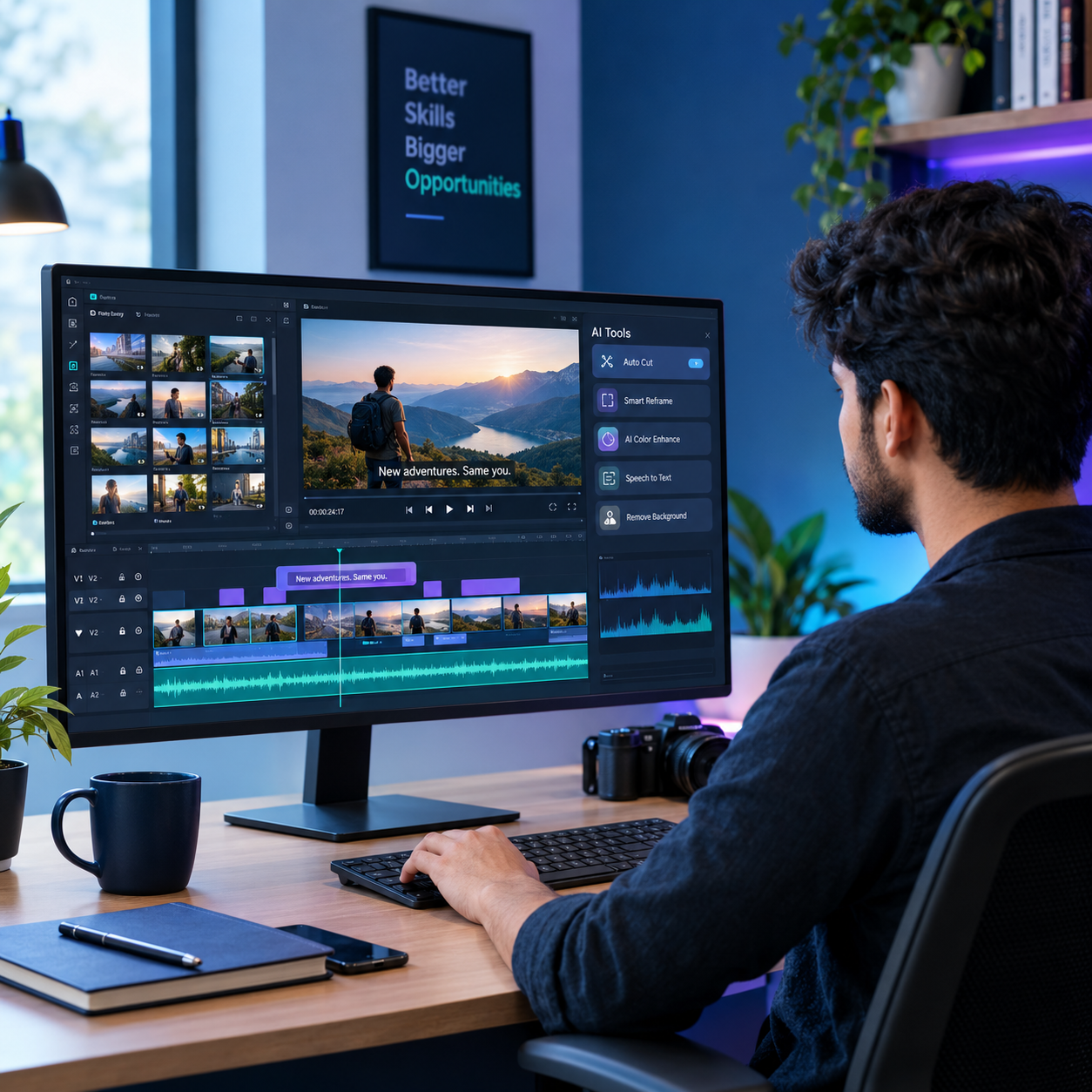
AI is becoming a useful part of the video production process. Tasks that once required considerable manual effort can now be assisted by intelligent tools, helping creators manage their time and experiment with different creative approaches.
Some common applications of AI in video editing include:
- Automated editing assistance: AI tools can help identify pauses, organise footage, and speed up certain editing tasks.
- AI-generated content: Creators can use supported tools to develop video clips, visual assets, backgrounds, and other creative elements.
- Automatic subtitles and transcription: Speech-to-text features can make it easier to create captions and prepare content for different audiences.
- Audio enhancement: AI-powered features can assist with reducing background noise and improving speech clarity.
- Content repurposing: Longer videos can be adapted into shorter clips for platforms such as Instagram Reels, YouTube Shorts, and other social media channels.
- Editing recommendations: Some applications provide suggestions for transitions, framing, colour adjustments, and other production improvements.
These features can make video production more efficient. However, their usefulness depends on how well the creator understands the project, chooses the appropriate tools, and reviews the final output.
Why Video Editing Skills Still Matter in the Age of AI
Although AI can assist with several technical tasks, it does not automatically understand every creative decision behind an effective video. A polished video requires more than combining clips or applying automated effects.
Professional editing skills help creators control the overall viewing experience. Important areas include:
- Storytelling: Arranging footage so that the message is clear and engaging.
- Pacing and timing: Deciding when to cut a scene, introduce information, or allow a moment to develop.
- Colour correction and grading: Maintaining visual consistency and creating the intended mood.
- Audio editing: Balancing dialogue, music, sound effects, and background audio.
- Transitions and motion graphics: Using movement and visual effects where they support the message.
- Audience understanding: Adapting the style, length, and format of a video to its intended viewers.
AI can support these decisions, but creators still need the judgement to decide what works. Learning editing fundamentals makes it easier to use automated features thoughtfully rather than relying on them for every creative choice.
Learners interested in developing these practical foundations can explore the Video Editing Course in Patiala.
How AI and Video Editing Work Together
AI and video editing are most useful when they complement each other. AI can help with preparation and repetitive tasks, while the editor focuses on storytelling, visual quality, and the purpose of the content.
Consider a small business that wants to create a promotional video for social media.
- Planning the content: AI tools can assist with brainstorming ideas, preparing an initial script, or outlining a video.
- Preparing the footage: The creator records product shots, demonstrations, or other relevant visuals.
- Editing the video: Editing software is used to arrange clips, adjust timing, improve audio, and maintain visual consistency.
- Using AI features: Suitable tools can assist with subtitles, audio cleanup, or adapting the video into shorter formats.
- Reviewing the final result: The creator checks the facts, spelling, sound, transitions, branding, and overall message before publishing.
This process shows why both technical editing knowledge and AI familiarity are useful. AI may help reduce the time spent on selected tasks, but the creator remains responsible for the final quality and accuracy.
Essential Skills Every Digital Creator Should Develop in 2026
Digital creators do not necessarily need to master every available tool. A stronger starting point is to build a practical foundation and gradually learn technologies that fit their work.
1. Understanding AI Tools and Their Applications
Creators should know what different AI tools can do, where they may be useful, and what limitations they have. This includes writing assistance, content ideation, transcription, image generation, video assistance, and workflow automation.
It is equally important to verify AI-generated information, review visual output, and avoid publishing content without checking it.
2. Learning Video Editing Software
Understanding an editing workflow is essential for producing organised, consistent videos. Beginners should become familiar with importing footage, arranging clips, working with timelines, adding titles, editing audio, using transitions, and exporting videos in suitable formats.
Once these fundamentals are understood, AI-assisted features become easier to evaluate and use effectively.
3. Developing Content and Storytelling Skills
A video should have a clear purpose. Creators need to understand what the audience should learn, feel, or do after watching it. Strong storytelling helps maintain attention and makes the content easier to understand.
This skill is relevant to promotional videos, educational content, product demonstrations, personal brands, and social media campaigns.
4. Creating Content for Different Platforms
A video created for YouTube may require a different structure from a short-form social media video. Creators should understand aspect ratios, video length, captions, opening hooks, readability, and platform-specific presentation.
Repurposing content can be efficient, but each version should still feel suitable for its intended platform and audience.
5. Combining Creativity With Technical Judgement
Knowing how to operate software is only one part of the process. Creators also need to make decisions about composition, timing, sound, visual consistency, and the appropriate use of effects.
The ability to review and improve AI-assisted work is an important part of developing a reliable creative workflow.
Why Learning AI Tools Alongside Video Editing Can Be Useful
Learning AI and video editing together can help creators understand the complete process of producing digital content. Instead of treating AI as a replacement for editing knowledge, learners can explore how it supports different stages of a project.
For example, AI may help generate initial ideas or captions, while editing skills help shape the footage into a coherent final video. This combination can also be useful when adapting content for different audiences, preparing promotional material, or managing recurring content tasks.
Learners who want to understand these applications can explore the AI Tools and Automation Course in Patiala. Combining AI familiarity with strong creative fundamentals can help learners build a more flexible skill set as digital production tools continue to develop.
Career Opportunities Related to AI and Video Editing
Video content is used across many areas of digital communication, including marketing, education, entertainment, e-commerce, and business promotion. As a result, video-related skills can be relevant to a range of creative roles.
Depending on their training, portfolio, experience, and interests, learners may explore areas such as:
- Video editor
- Social media video creator
- Short-form content editor
- YouTube video editor
- Freelance video production
- Digital content creator
- AI-assisted content production
- Video content support for marketing teams
These are possible career directions, not guaranteed outcomes. Building a portfolio, practising with real projects, understanding client requirements, and continuously improving technical skills are important steps towards professional development.
How Kamal Media Academy Connects Learning With Practical Skills
Learning digital tools is more effective when theoretical understanding is supported by practical work. For aspiring creators, this means gaining familiarity with editing workflows, experimenting with suitable AI applications, and learning to evaluate the quality of the final content.
At Kamal Media Academy, learners can explore training options related to video editing and AI tools. Those considering a course should review the curriculum, practical activities, software covered, and learning outcomes to understand how the training matches their goals.
You can also explore the academy’s student work to see examples of creative projects, and visit the Kamal Media Academy blog for more learning resources on digital skills and related topics.
Frequently Asked Questions
1. Will AI replace video editors in 2026?
AI can automate or assist with certain editing tasks, but video production still involves storytelling, creative judgement, timing, sound, and quality control. Learning to work with AI tools can help editors adapt to changing workflows.
2. Is video editing worth learning for beginners?
Video editing can be a useful skill for people interested in content creation, social media, marketing, and digital media. Beginners should start with editing fundamentals and practise by creating different types of videos.
3. Do I need coding skills to use AI tools for video editing?
Many AI-assisted editing tools can be used without coding. The skills required depend on the particular software and the complexity of the workflow. Beginners can start with accessible tools and develop their knowledge gradually.
4. Which skills should I learn first: AI or video editing?
The right starting point depends on your goals. Learning basic editing first can help you understand how videos are structured, while exploring AI tools introduces ways to assist with specific tasks. Learning both progressively can provide a useful combination.
5. How can I learn AI tools and video editing in Patiala?
You can compare the available course details, curriculum, practical learning opportunities, and training requirements at Kamal Media Academy. Reviewing the individual Video Editing Course and AI Tools and Automation Course can help you decide which option aligns with your learning goals.
Conclusion
AI is changing how digital content is planned, produced, and edited, but strong creative fundamentals remain important. Understanding editing techniques, developing storytelling skills, learning to evaluate AI-generated output, and adapting content for different platforms can help digital creators work more confidently with modern tools.
For anyone interested in developing these skills, the most useful approach is to combine practical video editing knowledge with a clear understanding of how AI can support the creative process. Exploring relevant training, practising consistently, and building a portfolio can help learners prepare for the evolving demands of digital content creation in 2026.