

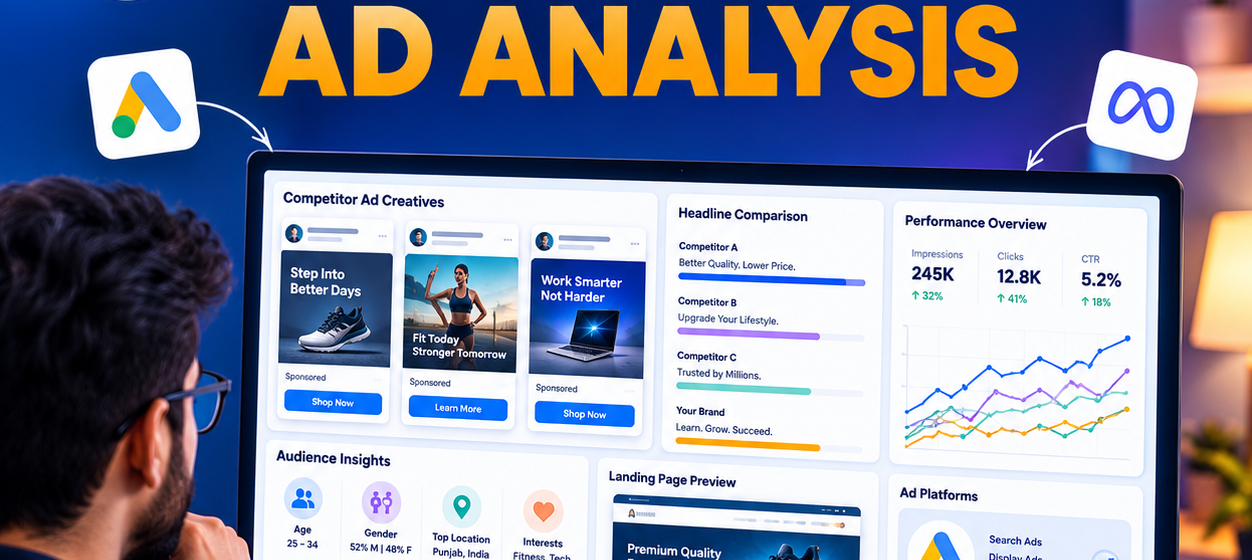
Creating an advertising campaign without researching the competition can lead to wasted budgets, unclear messaging, and disappointing results. Before launching ads on Google, Facebook, or Instagram, it is worth understanding what other businesses are doing, how they communicate with their audiences, and what makes their offers stand out.
Competitor ad analysis helps marketers make more informed decisions about ad creatives, headlines, targeting strategies, landing pages, and campaign objectives. Instead of copying another business, you can identify market trends, discover gaps in its messaging, and develop original campaigns that better match your audience’s needs.
For students, business owners, and aspiring digital marketers, learning how to analyse competitor ads is an essential performance marketing skill. At Kamal Media Academy, learners can build their understanding of digital advertising, campaign planning, and marketing strategy through practical learning that connects concepts with real-world applications.
What Is Competitor Ad Analysis?
Competitor ad analysis is the process of studying advertisements published by businesses competing for a similar audience. It involves reviewing their messaging, visuals, offers, calls to action, landing pages, and advertising channels to understand how they present their products or services.
For example, suppose you run a digital marketing training institute in Patiala. You might research how other institutes promote their courses, communicate their practical training opportunities, explain course benefits, and encourage students to enquire about admissions.
This research can help you identify questions your own advertisements should answer. Are potential students looking for practical projects? Do they want to learn Google Ads, Meta Ads, or AI-powered marketing tools? Are they more interested in career opportunities or business growth?
The answers can help you develop more relevant advertising messages rather than relying on generic promotional claims.
Why Should You Analyse Competitor Ads Before Launching a Campaign?
Competitor research is useful because it gives you a clearer picture of the market before you invest in advertising. It does not guarantee better results, but it can help you make more thoughtful decisions.
1. Understand What Your Audience Responds To
Competitors often communicate the same core benefits in different ways. One advertisement may focus on affordability, while another highlights expertise, convenience, practical experience, or customer support.
Study these differences to understand the various ways businesses position themselves. Then consider which message is most relevant to your own audience.
Do not assume that an advertisement is successful simply because it looks professional or has been running for a long time. Use it as a source of research, not proof of performance.
2. Identify Gaps in Competitor Messaging
One of the most valuable outcomes of competitor ad research is discovering what other advertisers have overlooked.
For instance, several course advertisements might promote digital marketing training without explaining whether students will work on live projects, practise campaign setup, or learn to interpret advertising reports.
If your training programme genuinely offers these learning opportunities, you can communicate them clearly in your own campaign.
The goal is not to make louder promises. It is to provide useful information that helps potential customers understand why your offer deserves consideration.
3. Improve Your Advertising Budget Decisions
Paid advertising involves testing different messages, audiences, formats, and landing pages. Without preparation, businesses may spend money testing ideas that could have been refined before launch.
Competitor research helps you create more focused hypotheses. You might test a benefit-led headline against a problem-solving headline or compare a short video with a static creative.
Your own campaign data must ultimately determine what works. Competitor analysis can guide your starting point, but it cannot replace performance tracking.
How to Analyse Competitor Ads Step by Step
A structured process makes competitor research easier to understand and apply. The following steps can be used for Google Ads, Facebook Ads, Instagram Ads, and other digital advertising campaigns.
Step 1: Identify Your Actual Competitors
Start by listing businesses that offer similar products or services to the same audience. Direct competitors deserve the most attention, but businesses with a different offer may also provide useful examples of advertising approaches.
Search Google for your main service keywords and review the advertisements that appear. On social platforms, look for businesses promoting similar products, courses, services, or offers.
For a digital marketing training institute, relevant competitors might include local training centres, online course providers, and institutes promoting specialised performance marketing programmes.
Create a shortlist of three to five relevant competitors. This is usually a manageable starting point for a focused analysis.
Step 2: Use Free Tools to Find Competitor Ads
You do not always need paid software to begin researching advertisements. Several free resources provide useful information about publicly visible ads.
Meta Ad Library
The Meta Ad Library allows users to search for advertisements running across Meta platforms, including Facebook and Instagram. You can review available ad creatives, copy, formats, and other displayed details.
Open the Meta Ad Library, select the relevant country and advertising category, and search for a business or brand. Review its available advertisements and note the different messages and creative formats it uses.
Google Ads Transparency Center
The Google Ads Transparency Center lets users search for advertisers and view eligible ads shown across Google’s advertising platforms. It is useful when researching how businesses communicate through text, image, and video advertisements.
Search for a competitor’s advertiser name and review the available ads, including the variations and formats displayed by the tool.
Google Search Results
Search Google using relevant commercial keywords and observe the advertisements that appear. Record the wording of visible headlines, the benefits being promoted, and the landing pages linked to the ads.
Remember that search results can vary by location, time, device, and personalisation. A single search does not provide a complete picture of a competitor’s advertising strategy.
Step 3: Analyse Headlines and Ad Copy
Your competitor’s headline is often the first element worth examining. It may focus on a customer problem, a desired outcome, a product feature, or a particular offer.
When analysing ad copy, ask yourself:
- What problem is the advertisement addressing?
- Which benefit appears most prominently?
- Does the message focus on the product or the customer’s outcome?
- Is the language specific or generic?
- Does the copy create a clear reason to take action?
For example, an advertisement promoting a digital marketing course could emphasise practical campaign skills rather than simply stating that admissions are open.
Use these observations to improve your own messaging. Do not copy competitors’ headlines or reproduce their advertising text. Develop an original message based on your offering and the needs of your customers.
Step 4: Evaluate Ad Creatives and Visual Design
Visual elements influence how quickly people understand an advertisement. Images, videos, typography, colour contrast, layout, and text placement can all affect how clearly the message is communicated.
Look for patterns in the advertisements you review. Are businesses using product demonstrations, student testimonials, short videos, educational graphics, or before-and-after examples? Does the creative explain the offer immediately, or does the viewer need to read several lines to understand it?
For a performance marketing campaign, you could develop multiple original creative concepts:
- A short video explaining a common advertising mistake.
- A graphic highlighting the practical skills taught in a course.
- A carousel explaining the stages of campaign planning.
- A student-focused creative describing a genuine learning opportunity.
The best format depends on your audience, placement, offer, and campaign objective. Test different approaches rather than assuming that one design style will work for every business.
Step 5: Examine Offers and Calls to Action
An advertisement may attract attention but still fail to generate enquiries if the offer is unclear or the next step feels confusing.
Review how competitors present their offers. Do they promote a free consultation, product demonstration, introductory session, discount, course details, or enquiry form? Look at the call to action and consider whether it matches the promise made in the advertisement.
For example, an advertisement encouraging beginners to explore performance marketing training should direct them towards a relevant course page or enquiry option, not an unrelated page.
Your own offer should be accurate, easy to understand, and consistent with the experience customers receive after clicking.
Step 6: Review the Landing Page Experience
Competitor research should not end with the advertisement itself. The landing page often provides important clues about how a business moves potential customers from interest to action.
Open the available destination page and assess its content from a prospective customer’s perspective.
Check whether the page explains the service clearly, answers common questions, presents relevant benefits, and offers an obvious next step. Also consider mobile usability, loading speed, readability, and the relevance of the page to the original ad.
For example, if an advertisement promotes Google Ads training, visitors should be able to find information about the course, its learning objectives, practical activities, and enquiry process without unnecessary searching.
Apply these observations to your own website, while keeping your content and design original.
Step 7: Compare Competitor Advertising Strategies
Once you have collected enough information, organise your findings in a simple comparison sheet. This makes it easier to identify recurring patterns and potential opportunities.
| Analysis area | What to examine |
| Audience | Who appears to be the intended customer? |
| Main message | Which problem or benefit is highlighted? |
| Creative format | Image, video, carousel, or text |
| Offer | What is being promoted? |
| Call to action | What should the viewer do next? |
| Landing page | Is the destination relevant and informative? |
| Opportunity | What useful information or benefit could your campaign communicate better? |
Keep observations separate from assumptions. You may be able to see an advertisement and its landing page, but you generally cannot determine the competitor’s actual conversion rate, advertising cost, customer acquisition cost, or profitability from public ad information alone.
Step 8: Turn Research Into Your Own Campaign Plan
The final step is to translate your findings into an actionable advertising plan.
Suppose your research shows that several training institutes use broad messages such as “Join Our Digital Marketing Course.” You might decide to test more specific messages focused on practical Google Ads experience, Meta campaign planning, or learning to measure advertising results.
Develop two or three distinct creative concepts, write original ad copy, choose a relevant audience, and send visitors to a matching landing page.
Define your success metrics before launching. Depending on the campaign objective, these might include qualified enquiries, conversion rate, cost per lead, or the cost of acquiring a customer.
After launch, use your own campaign data to assess performance. Pause or revise underperforming variations when the evidence supports doing so, and continue testing promising ideas.
Common Mistakes to Avoid During Competitor Ad Analysis
Even a detailed research process can become unhelpful when the findings are interpreted incorrectly.
Copying Competitor Advertisements
An advertisement that looks appealing may not suit your brand, audience, or offer. Copying its wording or creative can also create intellectual property and brand differentiation problems.
Instead, identify the underlying marketing principle and apply it to your own business.
Assuming Long-Running Ads Are Profitable
An advertisement’s visible duration does not establish its profitability. Advertisers may keep campaigns active for many reasons, and public ad libraries generally do not reveal the full performance data needed to judge success.
Use ad longevity as a research clue, not a reliable performance benchmark.
Ignoring Your Own Campaign Data
Competitor research provides direction, but actual results depend on factors such as audience relevance, offer quality, creative execution, landing page experience, and campaign setup.
Measure your own results and use them to guide future decisions.
Focusing Only on the Advertisement
A strong creative cannot compensate for an irrelevant landing page, unclear pricing information, a confusing enquiry process, or a weak offer. Evaluate the complete customer journey rather than judging the advertisement in isolation.
How AI Can Improve Competitor Ad Research
AI tools can make the analysis process more organised when used with reliable source material and human judgement.
For example, marketers can use AI to categorise collected ad headlines by message type, identify recurring themes, compare calls to action, brainstorm original creative angles, or organise research into a structured worksheet.
AI can also help generate alternative headlines and advertising copy for testing. However, it should not be treated as a source of verified competitor performance data. Any conclusions must be checked against the original advertisements and your own campaign results.
Combining AI-assisted analysis with practical advertising knowledge can help marketers work more efficiently while maintaining accuracy and originality.
Learn Performance Marketing and Digital Advertising at Kamal Media Academy
Understanding competitor advertisements is one part of becoming a capable digital marketer. To plan campaigns effectively, learners also need to understand audience research, creative development, campaign objectives, conversion tracking, budget management, and performance reporting.
Kamal Media Academy in Patiala is a suitable option to explore if you want to learn digital marketing through a structured course and develop practical knowledge of online promotion.
If you want to learn performance marketing, Google Ads, Meta Ads, and digital marketing with AI, explore the relevant courses offered by Kamal Media Academy. These skills can help learners understand how to research advertising opportunities, build campaign strategies, measure results, and make informed marketing decisions.
Before enrolling, review the current course syllabus, practical training arrangements, available project work, and course details to find the programme that matches your goals.
Whether you are a beginner, a student exploring digital marketing as a career, or a business owner who wants to understand paid advertising, learning the principles behind effective campaigns can give you a more structured approach to online growth.
Frequently Asked Questions
1. How can I analyse competitor ads for free?
You can start with the Meta Ad Library, Google Ads Transparency Center, and Google Search. These resources help you examine publicly available advertisements, messaging, creative formats, and destination pages without requiring a paid competitor-research subscription.
2. How do I analyse competitors’ Facebook and Instagram ads?
Search for a business in the Meta Ad Library and review its available ads. Examine the opening message, visual format, advertised offer, call to action, and linked landing page. Use these observations to develop original ideas for your own campaign.
3. Can I see how much my competitors spend on ads?
Public ad transparency tools do not generally provide the complete spending and profitability information needed to calculate a competitor’s advertising performance. Some political or issue-related advertisements may have additional disclosures, depending on the platform and jurisdiction.
4. What should I check when analysing a Google Ads competitor?
Review the visible ad headlines, descriptions, promoted benefits, search intent, and destination page. Compare how different advertisers address the same customer need, then use your findings to create more relevant messaging and landing pages.
5. What is the difference between competitor ad analysis and competitor SEO analysis?
Competitor ad analysis focuses on paid advertising, including creative messaging, offers, calls to action, and landing pages. Competitor SEO analysis focuses on organic search visibility, keywords, website content, backlinks, and technical optimisation. Both can inform a broader digital marketing strategy.
6. How many competitors should I analyse before launching a campaign?
Three to five relevant competitors are a practical starting point for many small campaigns. The ideal number depends on the size of the market, the campaign budget, and how much useful information is available.
7. Can AI help with competitor ad analysis?
Yes. AI can help organise ad observations, group similar messaging, identify potential content gaps, and brainstorm original creative variations. However, marketers should verify findings against the source material and use actual campaign analytics to evaluate performance.
8. Why should beginners learn competitor ad analysis?
It helps beginners understand how advertising messages are structured, how offers are communicated, and how landing pages support campaign objectives. It also provides a practical foundation for learning campaign planning, creative testing, and performance measurement.
9. Where can I learn Google Ads and Meta Ads in Patiala?
If you want to learn Google Ads, Meta Ads, performance marketing, and digital marketing with AI, you can explore the relevant training options at Kamal Media Academy in Patiala. Review the current course details and practical learning opportunities before choosing a programme.
10. Is performance marketing useful for a digital marketing career?
Performance marketing is useful for people interested in paid advertising, lead generation, e-commerce campaigns, and measurable marketing outcomes. Learning campaign setup, conversion tracking, budget management, and data analysis can help you build relevant skills for digital marketing roles and business projects.
How Competitor Ad Research Helps You Build Better Campaigns
Competitor ad analysis is not about finding an advertisement to copy. It is about understanding how other businesses communicate, recognising opportunities in the market, and developing a campaign that gives your own audience a clear reason to take action.
Start with free research tools, document your findings, review the complete landing page experience, and test your own ideas using measurable objectives. Over time, this process can help you make more informed advertising decisions.
For anyone looking to develop these skills, Contact Kamal Media Academy offers a relevant place to explore digital marketing training in Patiala, including learning opportunities related to performance marketing, Google Ads, Meta Ads, and digital marketing with AI. Build your knowledge, practise with real advertising scenarios, and use evidence from your campaigns to improve your approach.